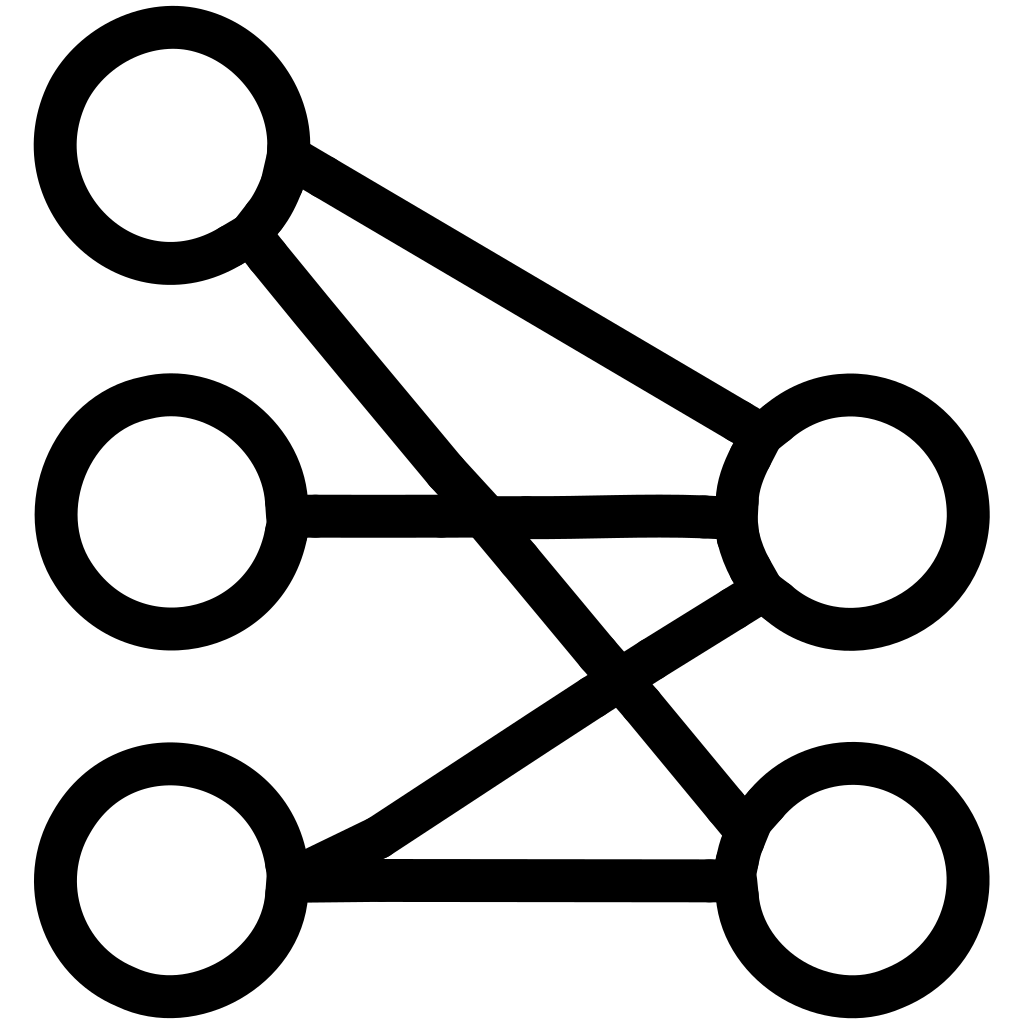
Stride controls how far the kernel moves between each application — a stride of 1 slides it one pixel at a time; a larger stride skips positions, producing a smaller, more downsampled output.
Formula for Output Size
\(W\) is the input's width (or height), \(K\) is the kernel size, \(S\) is the stride.
Numerical Example
An input of width 7, kernel size 3, stride 1: \(\lfloor\frac{7-3}{1}\rfloor+1 = 5\) — the kernel visits 5 positions. With stride 2 instead: \(\lfloor\frac{7-3}{2}\rfloor+1 = 3\) — skipping every other position, producing a smaller output.
Diagram
A larger stride visits fewer positions, producing a smaller output feature map — a form of built-in downsampling.
Why Increase Stride
| Effect of Larger Stride | Consequence |
|---|---|
| Smaller output feature map | Less computation and memory for subsequent layers |
| Larger effective receptive field growth per layer | Each subsequent layer's neurons "see" a proportionally larger region of the original input, faster |
| Coarser spatial resolution | Some fine-grained spatial detail is lost — a tradeoff against the computational savings |
Code
import torch
import torch.nn as nn

x = torch.randn(1, 3, 32, 32)

conv_stride1 = nn.Conv2d(3, 16, kernel_size=3, stride=1)
print(conv_stride1(x).shape)   # torch.Size([1, 16, 30, 30])

conv_stride2 = nn.Conv2d(3, 16, kernel_size=3, stride=2)
print(conv_stride2(x).shape)   # torch.Size([1, 16, 15, 15]) -- noticeably smaller output
Common Mistakes
- Forgetting stride affects output size, and hard-coding a fully-connected layer's expected input size without recomputing it after changing stride — a very common source of shape-mismatch errors when experimenting with an architecture.
- Assuming stride is only relevant to convolution — pooling operations (covered later in this category) apply the exact same stride concept.
Interview Relevance
Q: "What's the effect of increasing a convolutional layer's stride from 1 to 2?" The kernel skips every other position, producing an output feature map roughly half the spatial size in each dimension — reducing computation and memory for subsequent layers, at the cost of some spatial resolution/detail. It's a common technique for downsampling within convolutional layers themselves, as an alternative or complement to separate pooling layers.
Practice Question
For an input of width 10, kernel size 3, and stride 2, compute the resulting output width using the formula above.
