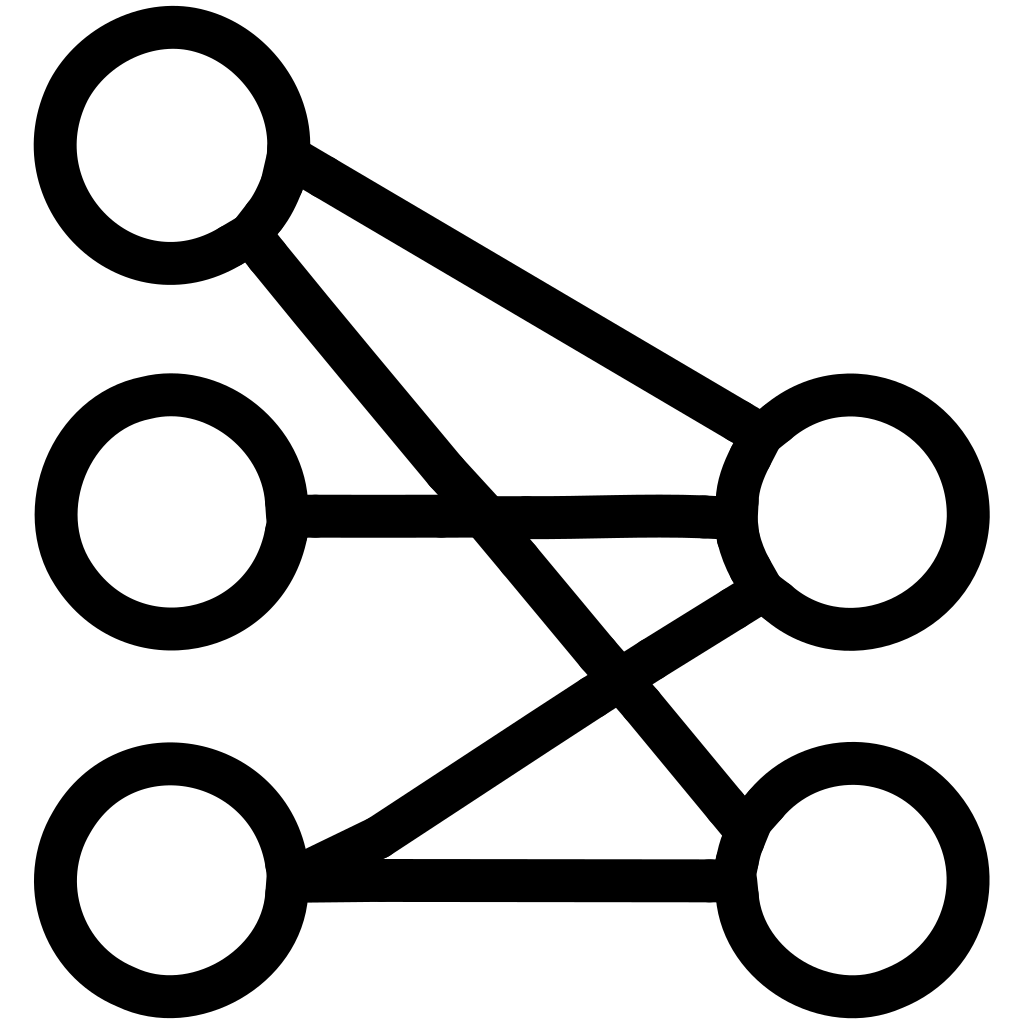
"Sparse categorical cross-entropy" sounds like a different loss function — it isn't. It's the exact same mathematical formula as categorical cross-entropy, differing only in the format the true labels are supplied in. This distinction matters mainly for TensorFlow/Keras naming; PyTorch sidesteps it entirely.
The Actual Difference — Label Format Only
| Categorical Cross-Entropy | Sparse Categorical Cross-Entropy | |
|---|---|---|
| Expected label format | One-hot encoded vector, e.g. \([0,0,1,0]\) | Integer class index, e.g. \(2\) |
| Underlying math | \(-\sum_c y_c\log\hat y_c\) | \(-\log\hat{y}_{y}\) (identical result, since one-hot collapses to this anyway) |
| Memory for labels | \(O(K)\) per example (K = number of classes) | \(O(1)\) per example |
As shown in Categorical Cross-Entropy, the one-hot sum always collapses to a single term — so mathematically these two are always identical for the same underlying data; "sparse" is purely about not wasting memory storing mostly-zero one-hot vectors.
Where the Naming Actually Matters — Keras
TensorFlow/Keras provides two explicitly separate loss classes because it expects you to hand it labels in whichever format your data pipeline naturally produces:
import tensorflow as tf

# If your labels are integers: [0, 2, 1, ...]
model.compile(loss=tf.keras.losses.SparseCategoricalCrossentropy(from_logits=True), ...)

# If your labels are already one-hot: [[1,0,0], [0,0,1], [0,1,0], ...]
model.compile(loss=tf.keras.losses.CategoricalCrossentropy(from_logits=True), ...)
Choosing the wrong one for your label format either throws a shape error or, worse, silently trains on garbage gradients — this is a genuinely common beginner mistake in Keras code specifically.
Why PyTorch Doesn't Have This Naming Split
PyTorch's nn.CrossEntropyLoss is built around integer class indices from the start — it's already what Keras calls "sparse." If you happen to have one-hot labels in PyTorch, you'd convert them to indices first (e.g. with .argmax(dim=1)) rather than look for a separate loss class.
Code — Verifying They're Mathematically Identical
import tensorflow as tf

logits = tf.constant([[2.0, 0.5, -1.0]])
sparse_label = tf.constant([0])
one_hot_label = tf.constant([[1.0, 0.0, 0.0]])

sparse_loss = tf.keras.losses.SparseCategoricalCrossentropy(from_logits=True)
categorical_loss = tf.keras.losses.CategoricalCrossentropy(from_logits=True)

print(sparse_loss(sparse_label, logits).numpy())        # identical value
print(categorical_loss(one_hot_label, logits).numpy())   # identical value
Common Mistakes
- Assuming "sparse" categorical cross-entropy is a mathematically different, more advanced loss — it's purely a label-format convenience; the loss values are identical to standard categorical cross-entropy given equivalent labels.
- Passing integer labels to Keras's
CategoricalCrossentropy(which expects one-hot) or one-hot labels toSparseCategoricalCrossentropy(which expects integers) — always match the loss class to your actual label format.
Interview Relevance
Q: "Is sparse categorical cross-entropy mathematically different from categorical cross-entropy?" No — they compute the exact same loss value for equivalent data; the only difference is the label format the API expects (integer class index vs. one-hot vector). The "sparse" version simply avoids the memory waste of storing mostly-zero one-hot vectors when labels are already available as class indices.
Practice Question
You're building a Keras model and your dataset's labels come as integers (e.g. 3 for the fourth class). Which of the two Keras cross-entropy loss classes should you use, and would you need to change anything if you instead had one-hot labels?
