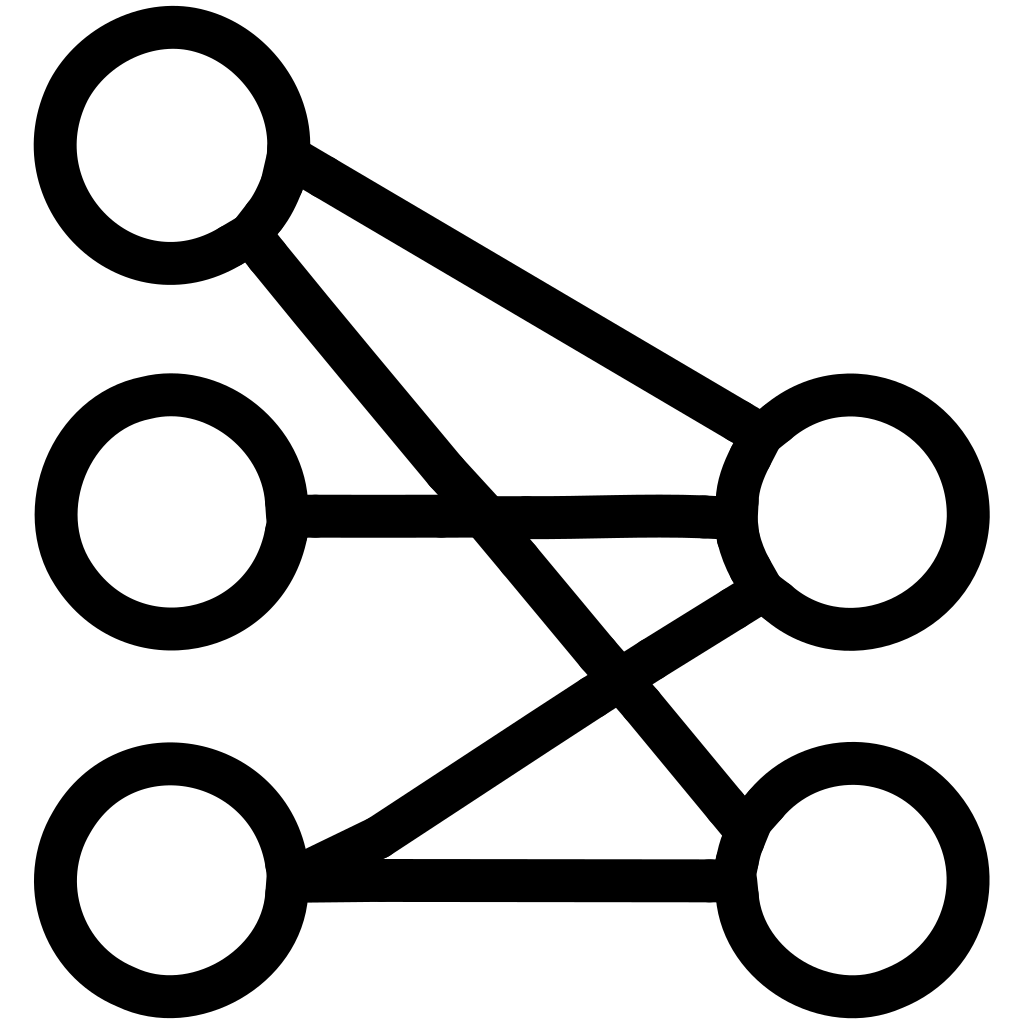
Every artificial neural network is a loose, deliberately simplified mathematical metaphor for one biological structure: the neuron. Understanding the biological original — briefly — makes the artificial version's design choices feel motivated rather than arbitrary.
The Biological Neuron's Structure
| Part | Role | Artificial Neuron Analog |
|---|---|---|
| Dendrites | Receive electrochemical signals from other neurons | Inputs \(x_1, x_2, \ldots, x_n\) |
| Synapses | Connection points that strengthen or weaken signal transmission based on experience | Weights \(w_1, w_2, \ldots, w_n\) |
| Cell body (soma) | Sums incoming signals | Weighted sum \(\sum w_ix_i + b\) |
| Axon hillock | Fires an electrical spike only if the summed signal exceeds a threshold | Activation function |
| Axon | Carries the output spike to other neurons | Output \(y\), passed to the next layer |
The Key Behavior Worth Borrowing: All-or-Nothing Firing
A biological neuron doesn't pass along a smoothly scaled version of its input — it either fires an electrical spike or it doesn't, based on whether accumulated signal crosses a threshold. This all-or-nothing, threshold-based behavior is exactly what the earliest artificial neuron models (starting with the next note, the McCulloch-Pitts neuron) tried to replicate mathematically, decades before "deep learning" existed as a term.
Where the Metaphor Breaks Down — And Why That's Fine
It's worth being precise about how loose this analogy actually is: real neurons communicate via discrete electrical/chemical spikes over time, form billions of dynamic, evolving connections, and their learning process (synaptic plasticity) is far more complex than gradient descent. Artificial "neurons" don't attempt biological realism — they borrow the structural idea (weighted inputs, a summing step, a firing decision) because it turns out to be a useful, trainable mathematical building block, not because it accurately models a brain.
Why This Note Exists in This Hub
Every term you'll use for the rest of this Neural Network Fundamentals category — "weight," "activation," "layer" — traces back to this loose biological vocabulary. Knowing the analogy up front means the next notes (McCulloch-Pitts Neuron, Perceptron, Artificial Neuron) read as refinements of one idea, not a list of unrelated new terms.
Common Mistakes
- Over-interpreting the biological analogy — deep learning research does not claim to simulate how brains actually learn; "neural network" is a historical name for a mathematical structure, not a neuroscience model.
- Assuming more "biologically realistic" artificial neurons are automatically better for deep learning tasks — decades of research show that simplified, purely mathematical neurons (with smooth activation functions, trained by backpropagation) are far more practical and effective for the engineering goal of function approximation.
Interview Relevance
Q: "How closely does an artificial neural network actually model a biological brain?" Only loosely, at the level of a structural metaphor — weighted inputs, summation, and a firing/activation decision. It borrows vocabulary and a rough architectural idea, not the underlying biology (which involves spiking dynamics, synaptic plasticity, and vastly more complex connectivity than any artificial network implements).
Practice Question
Match each artificial neural network term to its biological inspiration: (a) weight, (b) activation function, (c) layer. What biological structure or process does each metaphorically stand in for?
