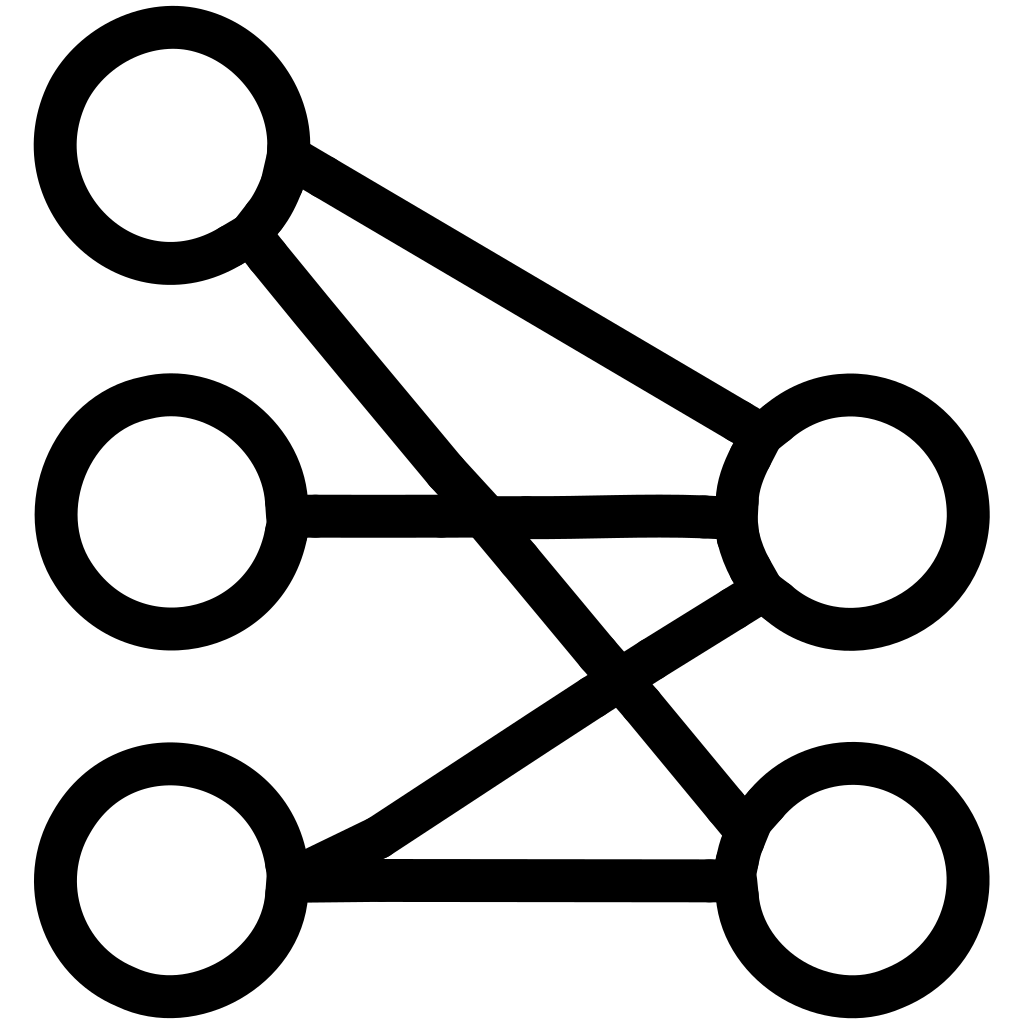
Mini-Batch Gradient Descent is the practical compromise between batch and stochastic gradient descent — and it's what virtually every real deep learning training run actually uses, whether or not the optimizer is casually called "SGD" in code.
Formula
Instead of one example (SGD) or the whole dataset (batch GD), each update uses a small, randomly sampled subset — a "mini-batch."
Why This Specific Compromise Wins
| Batch GD | SGD | Mini-Batch GD | |
|---|---|---|---|
| Gradient noise | None | High | Moderate — averages out much of SGD's noise |
| Update frequency | Once per epoch | Once per example | Once per batch — frequent, but not wastefully so |
| GPU/hardware utilization | Good (large matrix ops), but rare updates | Poor — one example doesn't fill a GPU's parallel capacity | Excellent — batches are sized to exploit GPU parallelism efficiently |
| Memory requirement | Must hold the full dataset's gradient computation | Minimal | Moderate, tunable via batch size |
Mini-batches, especially at sizes like 32–256, are large enough to average out most of SGD's noisy variance and small enough to fit comfortably in GPU memory while keeping matrix operations efficiently parallelized — the sweet spot that made it the default.
Code — Connecting to PyTorch's DataLoader
import torch
from torch.utils.data import DataLoader, TensorDataset

X = torch.randn(10000, 5)
y = torch.randn(10000)
dataset = TensorDataset(X, y)
loader = DataLoader(dataset, batch_size=64, shuffle=True)   # this IS mini-batch gradient descent

w = torch.zeros(5, requires_grad=True)
optimizer = torch.optim.SGD([w], lr=0.01)

for epoch in range(5):
    for X_batch, y_batch in loader:   # each iteration = one mini-batch update
        predictions = X_batch @ w
        loss = ((predictions - y_batch) ** 2).mean()
        loss.backward()
        optimizer.step()
        optimizer.zero_grad()
Note that torch.optim.SGD is the same optimizer class used here, whether you feed it one example, a mini-batch, or the whole dataset at once — the "SGD vs mini-batch vs batch" distinction is about how you construct your DataLoader and training loop, not a different optimizer class.
Choosing a Batch Size
| Batch Size | Effect |
|---|---|
| Small (e.g. 8–32) | More noise (closer to SGD), more frequent updates, lower memory use |
| Large (e.g. 256–1024+) | Smoother gradient estimate (closer to batch GD), fewer updates per epoch, higher memory use, often requires a proportionally larger learning rate |
Common Mistakes
- Choosing a batch size purely for GPU memory convenience without considering its effect on gradient noise and generalization — very large batch sizes can sometimes generalize slightly worse without other adjustments (like learning rate scaling).
- Forgetting to shuffle the dataset before batching — without shuffling, each epoch sees mini-batches in the same fixed order, which can introduce unwanted correlation between consecutive updates.
Interview Relevance
Q: "When people say a model was trained with 'SGD,' what are they usually actually describing?" Almost always mini-batch gradient descent — using an optimizer like torch.optim.SGD with a DataLoader that yields batches of, say, 32 or 64 examples per update, not literal single-example stochastic gradient descent. The "SGD" naming is a historical holdover.
Practice Question
A dataset has 50,000 examples. With a batch size of 100, how many weight updates happen in one epoch?
