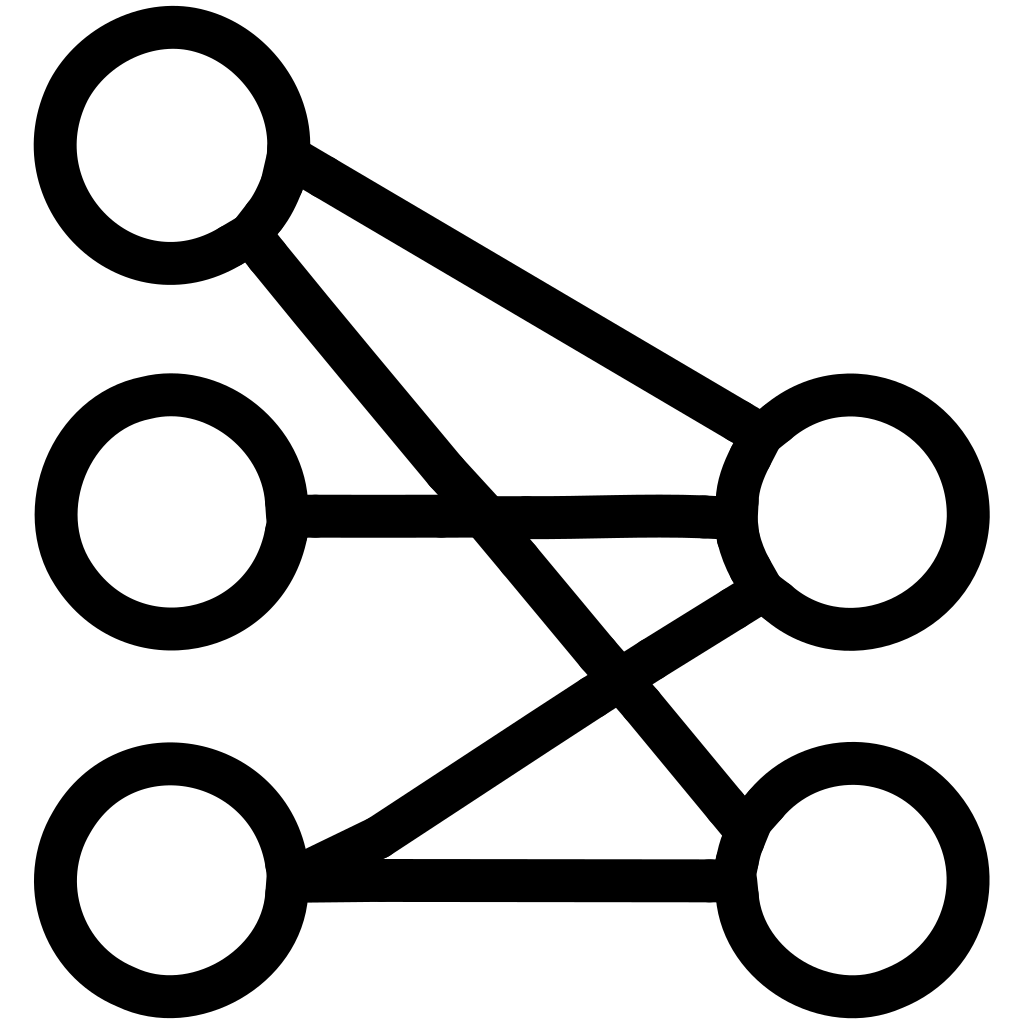
Pooling downsamples a feature map — summarizing each small local region into a single value — reducing computation, adding a degree of translation robustness, and helping control overfitting, all without introducing any new learnable parameters.
The General Idea
Like convolution, pooling slides a small window across the input, but instead of computing a weighted dot product with learnable weights, it applies a fixed, parameter-free summary function — most commonly the maximum (next note) or the average (the note after) of the values in that window.
Why Pooling Helps
| Benefit | Explanation |
|---|---|
| Reduces spatial size | Fewer values to process in subsequent layers, reducing computation and memory |
| Adds local translation robustness | A small shift in exactly where a pattern appears within the pooling window still produces roughly the same pooled output, since the summary function ignores exact position within that window |
| No learnable parameters | Unlike convolution, pooling adds zero parameters to the model — a "free" way to reduce dimensionality without any additional overfitting risk from extra weights |
Formula for Output Size
Pooling uses the exact same output-size formula as convolution (see Stride and Padding), with the pooling window playing the role of the kernel:
Pooling windows commonly use a stride equal to the window size (e.g. a 2×2 window with stride 2), so each region of the input is summarized exactly once, with no overlap — this specific, common configuration is what halves the spatial dimensions.
Diagram
Each non-overlapping 2×2 region is summarized down to one value — halving both spatial dimensions.
Common Mistakes
- Assuming pooling has learnable parameters, the way convolution does — it doesn't; it's a fixed, deterministic summary operation, which is exactly why it doesn't contribute to the model's overfitting risk the way additional weighted layers would.
- Applying so much pooling that critical spatial detail is lost entirely before the network has extracted enough useful features — pooling frequency and placement is itself a design choice with real tradeoffs.
Interview Relevance
Q: "What does pooling add to a CNN that convolution alone doesn't provide?" Pooling reduces spatial dimensions without adding any learnable parameters, and it provides a degree of local translation robustness — since it summarizes a whole local region into one value, a small shift in exactly where a pattern occurs within that region barely changes the pooled output. This complements convolution's own translation-equivariant weight sharing, adding an extra layer of robustness at no parameter cost.
Practice Question
Why does pooling not increase a model's total number of learnable parameters, unlike adding another convolutional layer would?
