This note revisits Mixture of Experts (MoE) specifically in the context of modern large-scale AI systems — why this architecture has become central to the largest, most capable models being built today.
The Core Idea, Recap
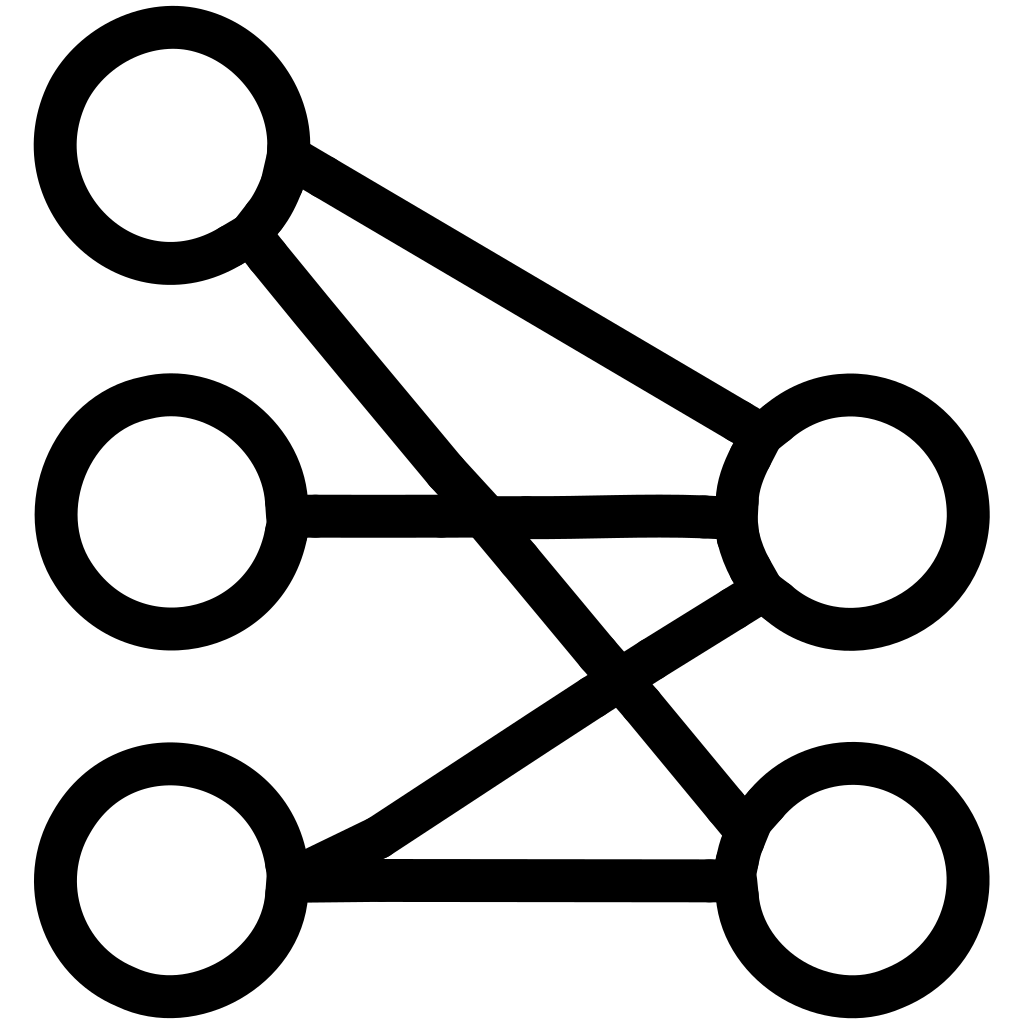
A Mixture of Experts layer replaces a single large feed-forward network with many smaller "expert" networks, plus a lightweight router that selects only a small subset of experts (often just 1-2 out of dozens) to actually process each individual token. This means the model has a very large total parameter count, but only a small fraction of those parameters are actually activated for any given input — decoupling total model capacity from per-token computational cost.
Why This Matters for Modern Large-Scale Models
| Dense Model | MoE Model |
|---|---|
| Every parameter is used for every token | Only a small subset of "expert" parameters is used per token |
| Total capacity is directly tied to compute cost per token | Total capacity can scale far beyond what per-token compute cost would otherwise allow |
| Simpler to train and serve | More complex — routing, load balancing across experts, and communication overhead in distributed settings |
This is precisely why several of the largest, most capable modern language models use MoE architectures — it allows scaling total model capacity (and thus potential capability) dramatically, without a proportional increase in the compute cost of running each individual token through the model.
Code — A Simplified MoE Layer
import torch
import torch.nn as nn
import torch.nn.functional as F

class MoELayer(nn.Module):
    def __init__(self, input_dim, hidden_dim, num_experts=8, top_k=2):
        super().__init__()
        self.experts = nn.ModuleList([
            nn.Sequential(nn.Linear(input_dim, hidden_dim), nn.ReLU(), nn.Linear(hidden_dim, input_dim))
            for _ in range(num_experts)
        ])
        self.router = nn.Linear(input_dim, num_experts)
        self.top_k = top_k

    def forward(self, x):
        router_logits = self.router(x)                      # (batch, num_experts)
        router_probs = F.softmax(router_logits, dim=-1)
        top_k_probs, top_k_indices = router_probs.topk(self.top_k, dim=-1)

        output = torch.zeros_like(x)
        for i in range(self.top_k):
            expert_idx = top_k_indices[:, i]
            weight = top_k_probs[:, i].unsqueeze(-1)
            for e in range(len(self.experts)):
                mask = (expert_idx == e)
                if mask.any():
                    output[mask] += weight[mask] * self.experts[e](x[mask])
        return output
The Load Balancing Challenge
Without any intervention, a router can learn to favor a small handful of "popular" experts, leaving others rarely used and effectively wasting their capacity — a phenomenon called expert collapse. Modern MoE training typically adds an auxiliary load-balancing loss term that explicitly encourages the router to distribute tokens more evenly across all available experts, ensuring the model's full capacity is actually utilized.
Common Mistakes
- Training an MoE model without a load-balancing auxiliary loss — this risks expert collapse, where the model effectively behaves like a much smaller dense model because most experts go unused.
- Assuming MoE always reduces total training cost — MoE reduces per-token inference/compute cost relative to total capacity, but training and serving infrastructure complexity (routing, cross-device communication for distributed experts) genuinely increases compared to a simpler dense architecture.
Interview Relevance
Q: "Why does Mixture of Experts allow scaling a model's total parameter count far beyond what a dense architecture's compute budget would otherwise allow?" In a dense model, every parameter participates in processing every single token, directly tying total model capacity to per-token computational cost. An MoE layer instead routes each token to only a small subset of available experts (e.g. 2 out of 64), meaning most of the model's total parameters are inactive for any given token — this decouples total capacity from per-token compute cost, allowing the model's overall parameter count (and thus potential knowledge/capability) to scale dramatically while keeping the actual computation performed per token comparable to a much smaller dense model.
Practice Question
Why might an MoE model without any load-balancing mechanism end up behaving similarly to a much smaller dense model in practice?
